The Port-Side Half of Maritime Logistics: Berths, Cranes, Yards, and Internal Transport
Vessel routing happens at sea, but the time a ship spends at port is often the larger share of its journey. Berth allocation, crane coordination, yard stacking, and internal vehicle routing all shape how long that stay lasts.

Vessel routing happens at sea, but the time a ship spends at port — waiting for a berth, being loaded and unloaded, having its cargo moved through the yard — is often a larger share of total transit time than the voyage itself. Container terminals are tightly constrained spaces where berths, cranes, storage yards, and internal vehicles all compete for the same limited capacity, and a delay in any one of these systems propagates through the others. The operations research literature treats these as a family of related scheduling and routing problems, each with a direct effect on how long a vessel — and its cargo — sits idle.
Vessel routing happens at sea, but the time a ship spends at port is often the larger share of its journey. Berth allocation, crane coordination, yard stacking, and internal vehicle routing all shape how long that stay lasts.
§ 02Assigning vessels to berths
Berth allocation determines where and when each incoming vessel will dock, and it has to balance berth availability, vessel size, cargo priorities, and the knock-on effect that one ship's late departure has on every vessel scheduled after it. Treated as a static scheduling problem, berth allocation tends to produce plans that look efficient on paper but degrade quickly once a single vessel arrives early, late, or with more cargo than expected. Allocation that incorporates predicted arrival times and expected handling duration — and that can be re-run as conditions change — keeps berth utilization high without requiring vessels to wait for a slot that a more flexible plan could have freed up earlier.
§ 03Coordinating cranes across yard and quay
Two related crane-scheduling problems run in parallel at any busy terminal. At the quay, cranes are assigned to ships to load and unload containers as quickly as possible, with the constraint that multiple cranes working the same vessel must avoid colliding and must have their workload balanced so that one crane doesn't finish early while another is still backed up. In the yard, a separate fleet of cranes moves containers between storage blocks and transport vehicles, where the goal is minimizing travel distance and idle time rather than minimizing a single ship's berth time. Both problems benefit from the same kind of forecasting — predicting which containers will be needed next and positioning cranes accordingly — but solving them independently can create new bottlenecks at the handoff points between yard and quay.
§ 04Stacking containers for fast retrieval
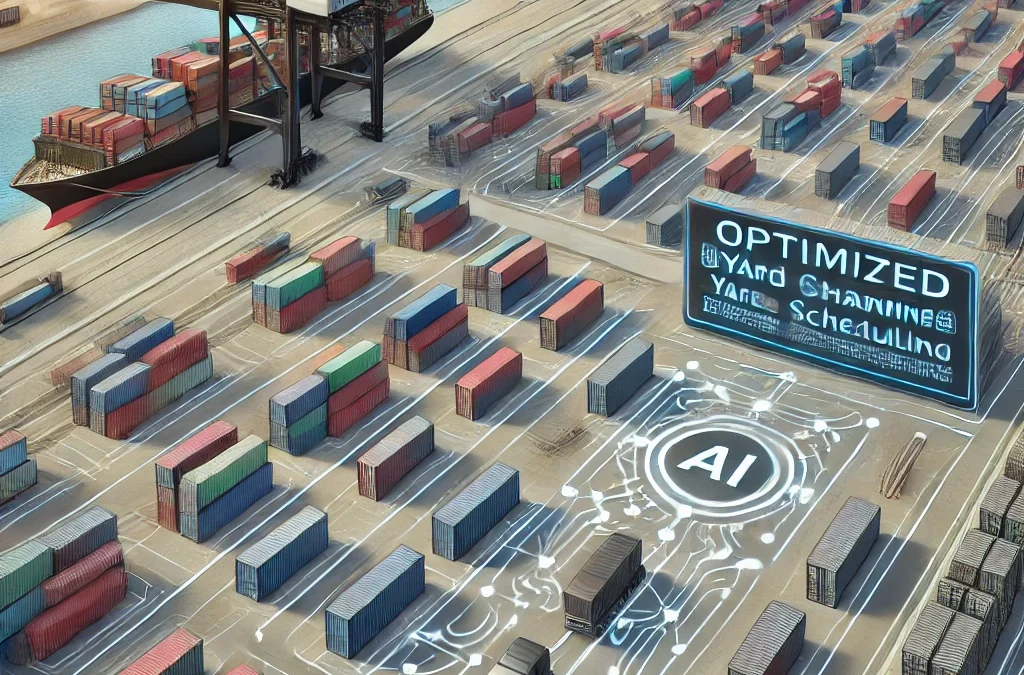
How containers are stacked in the yard determines how much rehandling is needed later: a container needed soon but buried under others that will leave later has to be temporarily moved out of the way, which is pure overhead. The stacking problem is fundamentally about sequencing — predicting the order in which containers will be requested for loading or pickup, and arranging the yard so that the containers needed soonest are the most accessible. Because yard space is limited and container types vary in how they can be stacked (weight, refrigeration requirements, hazardous classifications), the problem doesn't reduce to a simple last-in-first-out rule, and getting it wrong compounds — each unnecessary move increases congestion for every move that follows.
§ 05Routing internal vehicles through a confined space
Trucks and automated guided vehicles move containers between the yard, the quay, and gate areas, and routing them efficiently is complicated by the fact that the terminal is a shared, congested space rather than an open road network. A route that's optimal in isolation can create a bottleneck if many vehicles are routed through the same corridor at the same time. Routing that accounts for real-time vehicle positions, pickup and delivery deadlines, and vehicle capacity can reduce congestion and idle time across the fleet, but the bigger gain comes from coordinating these routes with the crane and yard schedules they're ultimately serving, rather than treating vehicle movement as a separate problem.