Maintenance Optimization for Municipal Water Pipelines: A Practical Framework
Most municipal utilities still schedule pipe replacement by age or budget cycle. The utilities getting more service life per dollar are scheduling by risk instead — and risk is a computable, not a guessed, quantity.

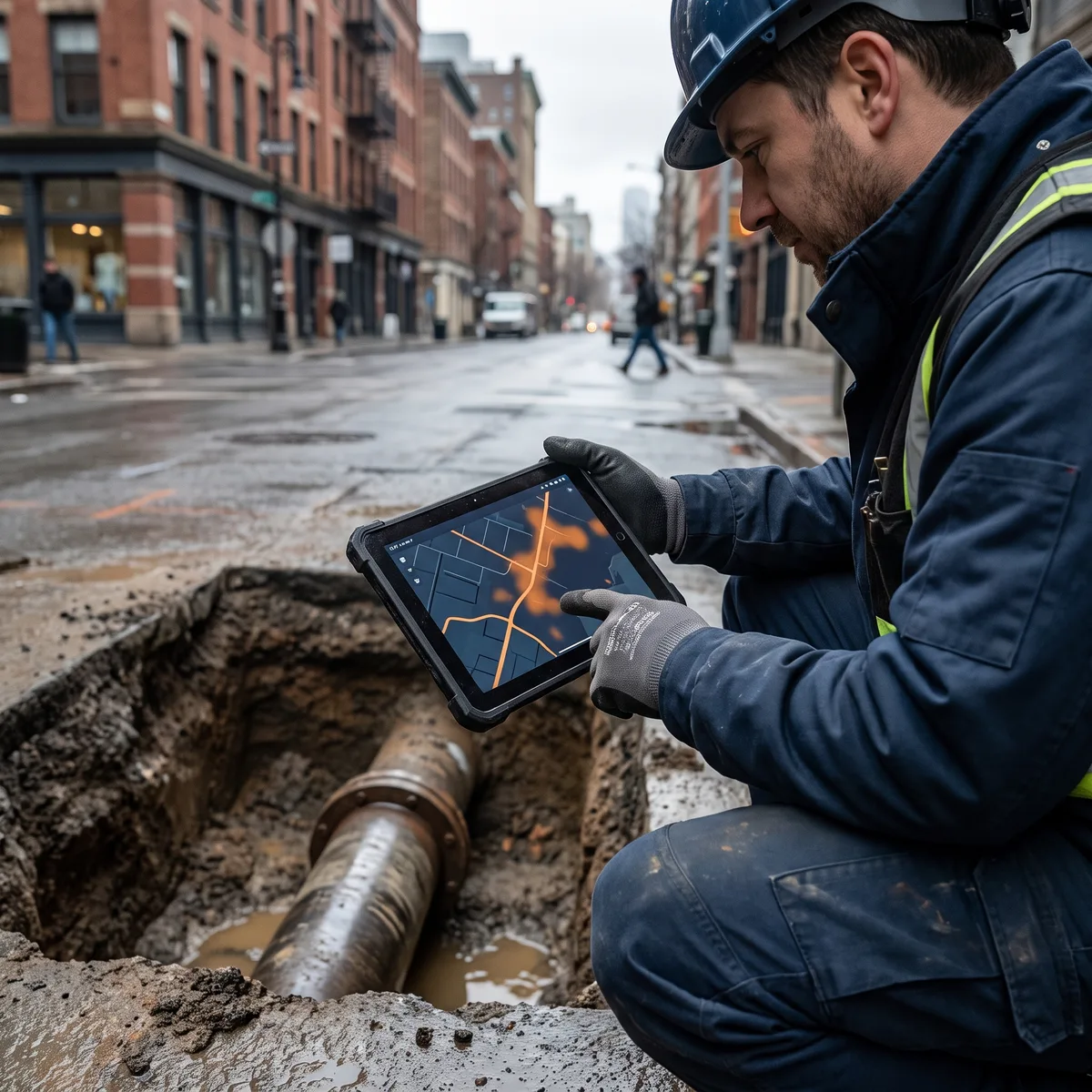
Most municipal water utilities still schedule pipe replacement primarily by installation age, updated against whatever capital budget survives that year's council session. Age is easy to track and easy to defend in a public meeting, but it is a weak proxy for the thing that actually matters: the probability a specific segment fails before its replacement is funded. A 60-year-old cast-iron main in stable, low-corrosivity soil can outlast a 15-year-old main running through reactive soil under a heavy-traffic road by decades — and an age-based schedule treats them identically.
Most municipal utilities still schedule pipe replacement by age or budget cycle. The utilities getting more service life per dollar are scheduling by risk instead — and risk is a computable, not a guessed, quantity.
§ 02What Actually Predicts Pipe Failure
The break-history literature is consistent on which variables carry the most signal: prior break count on the same segment (the single strongest predictor — a pipe that has already broken once is measurably more likely to break again), pipe material and diameter, soil corrosivity class, operating pressure, and external loading from traffic or nearby construction. A hazard-function model — the same family of survival-analysis tools used for mechanical asset replacement timing — fit on a utility's own break history turns those variables into a per-segment failure probability over a planning horizon, rather than the single age threshold most capital plans still use.
§ 03Prioritizing a Finite Renewal Budget
A ranked risk score only becomes useful once it is turned into a renewal sequence under an actual budget constraint, and that step is a combinatorial optimization problem, not a spreadsheet sort: the objective is minimizing expected total cost (renewal cost plus the expected cost of failures on segments left unreplaced) subject to the capital available in a given year, which segments can be grouped into the same dig to share mobilization cost, and which segments interact — replacing one main sometimes lets a utility defer a lower-risk neighboring segment without a separate excavation. Solved as a straight priority sort, a utility over-invests in the top few highest-risk segments and under-invests in cheaper joint-replacement opportunities the sort can't see.
§ 04Where Real-Time Monitoring Changes the Picture
A hazard model built only on periodic inspection and historical break data is still working from a snapshot that ages between updates. Pressure sensors and acoustic leak-detection deployed across a distribution network let the same underlying risk model update continuously — a sustained pressure anomaly or an acoustic signature consistent with a developing leak moves a specific segment's risk score in real time, ahead of the next scheduled inspection cycle, rather than waiting for the next annual data refresh to notice.
§ 05Building the Business Case for a Utility Board
A risk score, however well-calibrated, does not get budget approved on its own — utility boards fund avoided cost, not statistics. The business case that lands is the one expressed as deferred capital spend (extending a segment's safe service life by years, verified against the model rather than assumed) and avoided emergency-repair cost, which routinely runs several times the cost of the same repair done on a planned basis, once traffic disruption, off-hours labor, and water-loss are counted. Framed that way, risk-based renewal planning is not a technology upgrade competing with other capital priorities — it is a way of making the existing renewal budget cover measurably more actual risk reduction per dollar.