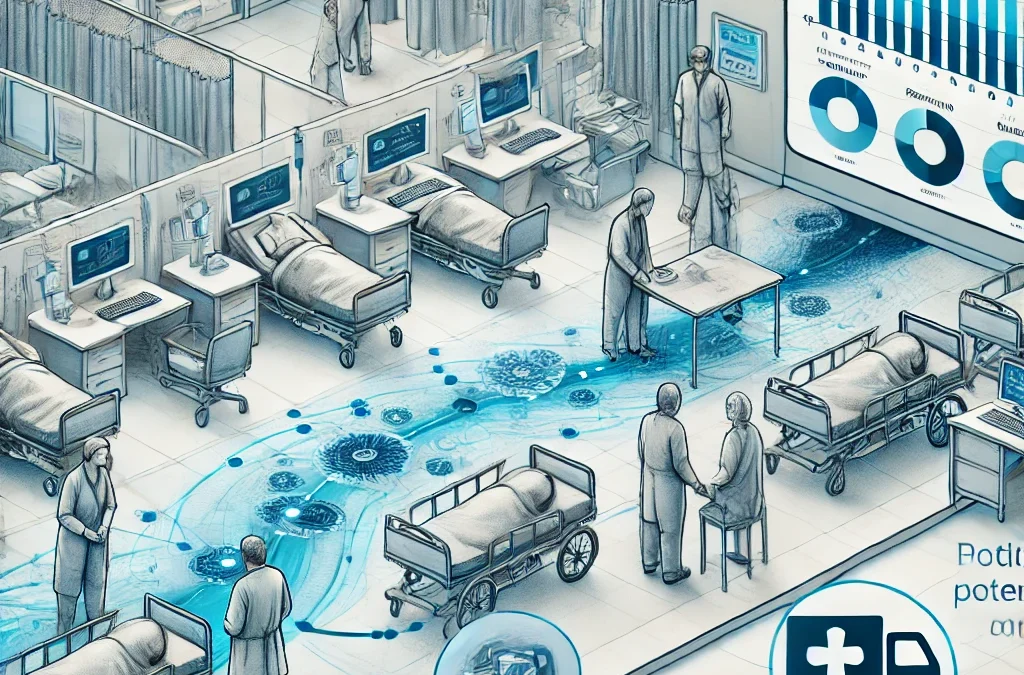
Optimization Beyond the Hospital: Logistics for Distributed Healthcare
Pharmacies, home-care agencies, vaccine distributors, and telehealth platforms form a distributed healthcare network with its own demand patterns, regulatory requirements, and failure modes.

Healthcare logistics doesn't end at the hospital's loading dock. Pharmacies, home-care agencies, vaccine distributors, and telehealth platforms form a distributed network that operates under many of the same constraints as hospital logistics — limited inventory, scarce skilled labour, time-sensitive deliveries — but without a single building to coordinate within. The optimization problems that arise here are less visible than hospital scheduling, but they affect a much larger share of day-to-day patient care.
Pharmacies, home-care agencies, vaccine distributors, and telehealth platforms form a distributed healthcare network with its own demand patterns, regulatory requirements, and failure modes.
§ 02Distributing medical supplies without overstock or shortage
Clinics, pharmacies, and home healthcare providers each draw on a shared pool of medical supplies and equipment, and the central challenge is keeping every site adequately stocked without tying up capital in inventory that sits unused. Demand at any single location is noisy — driven by patient mix, seasonal illness patterns, and local health events — but aggregated across a network it becomes more predictable, which is what makes centralized forecasting valuable. Systems that combine historical consumption data with regional health signals can set reorder points and distribution schedules that adapt to demand shifts before they cause stockouts. The same systems are useful in reverse: when a supply disruption occurs at one node, rerouting from a better-stocked location is often faster than waiting for replenishment from a central warehouse.
§ 03Scheduling care that travels to the patient
Home healthcare inverts the usual logistics problem: instead of moving goods to a fixed point, the provider has to bring a person — with specific skills, equipment, and a finite working day — to a scattered set of locations. A naive schedule that simply lists visits in the order they were booked tends to produce long, inefficient routes and uneven workloads. Scheduling that accounts for travel time between visits, the urgency and duration of each appointment, and which staff have the right qualifications for a given case can substantially reduce total travel distance while keeping wait times for patients low. Because home healthcare schedules are disrupted constantly — cancellations, urgent add-ons, traffic — the value of a scheduling system lies as much in how cheaply it can be re-optimized as in the quality of the original plan.
§ 04Keeping temperature-sensitive products within range
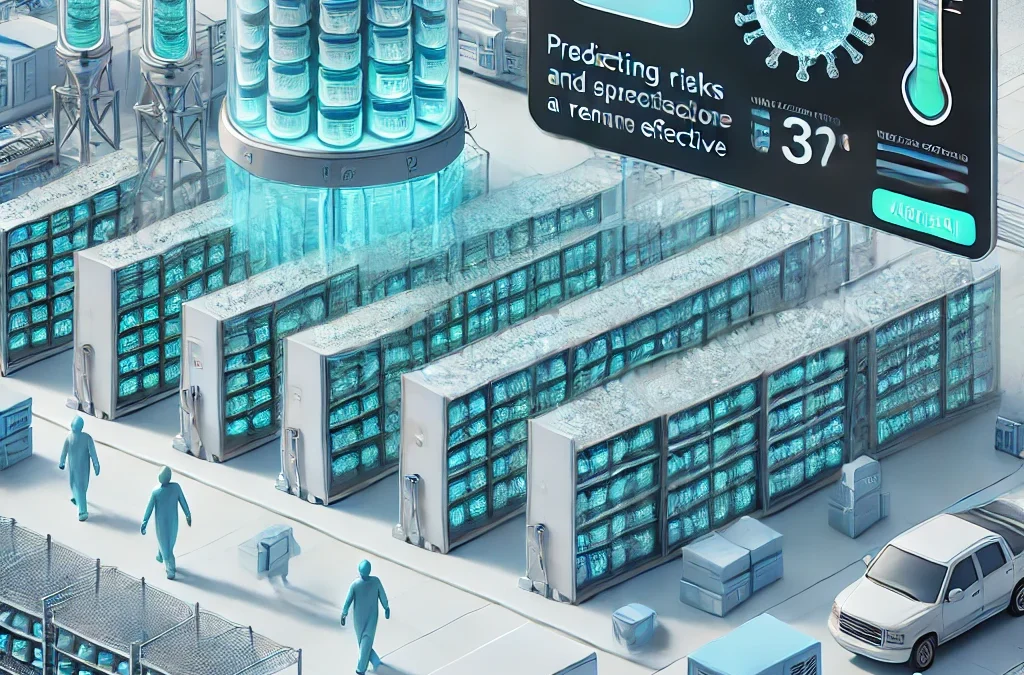
Vaccines and many medications are only effective if they stay within a narrow temperature band from the point of manufacture to the point of use, and a single equipment failure or delayed handoff can render an entire shipment unusable. Cold chain monitoring increasingly relies on continuous sensor data rather than periodic spot checks, which makes it possible to catch a developing problem — a refrigeration unit drifting out of range, a delivery running behind schedule in hot weather — before the product is compromised. The useful step beyond monitoring is prescription: when a deviation is detected, the system can recommend rerouting a shipment, adjusting storage conditions at a waypoint, or prioritizing a delivery, rather than simply flagging the problem after the fact.
§ 05Distribution routing and on-demand virtual care
Getting medications from central warehouses to pharmacies and patients' homes is a routing problem shaped by delivery urgency, vehicle capacity, and real-time traffic — not unlike commercial last-mile delivery, but with tighter tolerances for delay on time-critical prescriptions. A related but structurally different problem has emerged with the growth of telemedicine: instead of routing a vehicle, the system is allocating clinician time across a pool of virtual appointments, matching patient demand — which spikes unpredictably — with available specialists. Both problems share an underlying logic: predict where demand will concentrate, and allocate a limited resource — a delivery slot, a clinician's calendar — before the gap between supply and demand becomes a wait time the patient feels directly.