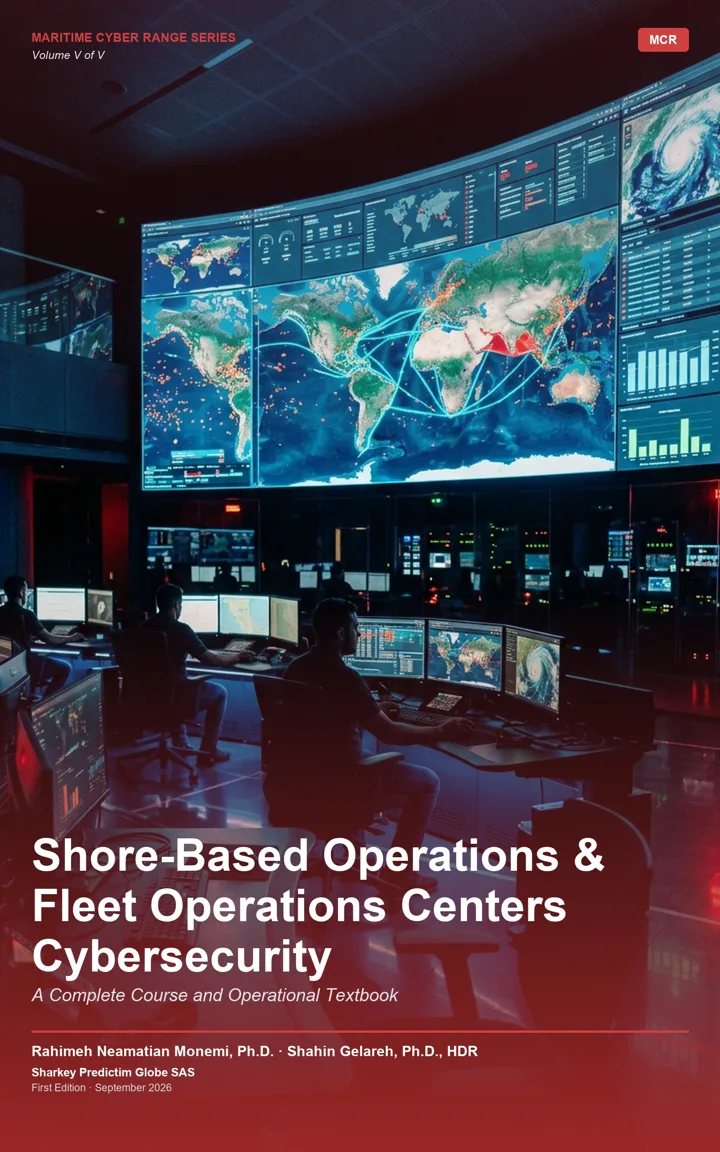
Shore-Based Operations & Fleet Operations Centers Cybersecurity
A Complete Course and Operational Textbook
Fleet telematics, coastal VTS and remote operations centres
Rahimeh Neamatian Monemi, Ph.D. · Shahin Gelareh, Ph.D.
Shore-Based Operations & Fleet Operations Centers Cybersecurity is a complete course for the shore-side teams — Fleet Operations Centres, maritime SOCs, VTS operators and Remote Operations Centres — who now carry as much responsibility for a fleet's safety as the ships themselves.
Across 30 chapters in six parts, it covers fleet telematics, remote monitoring and voyage optimisation, coastal VTS, radar and AIS shore infrastructure, Remote Operations Centres and Maritime Autonomous Surface Ships (teleoperation links, handover and fallback), maritime SOC architecture, threat hunting and incident response, and enterprise governance, from bunker-fuel fraud to managed-service-provider security.
Every chapter follows the same structure: learning objectives, key terminology, a documented incident or a clearly labelled illustrative scenario, a safety warning, a step-by-step technical runbook, a mapping to the relevant regulatory and industry frameworks, and a Platform Lab Session that readers can optionally run hands-on on the Maritime Cyber Range platform. The book is complete on its own; the platform is an optional companion, and worked lab solutions are supplied to adopting instructors.
Six parts, one platform lab per chapter
PART IMaritime Shore Operations Architecture & Threat LandscapeCh. 1–5
- 1Fleet Operations Center (FOC) Ecosystem: Telemetry, Diagnostics & Optimization
- 2Threat Actors, Espionage & Piracy Targeting Shore Infrastructure
- 3Regulatory Frameworks: IMO Guidelines, IACS UR E26/E27, NIS2 & ISO 27001
- 4Cyber-Physical Risk Assessment for Fleet-Wide Shore Management Systems
- 5Shore Enterprise Network Architecture, IT/OT DMZs & Secure Fleet Gateways
PART IIFleet Telematics, Remote Monitoring & Voyage OptimizationCh. 6–10
- 6Satellite Telemetry Ingestion, MQTT/Kafka Pipelines & Cloud Fleet Portals
- 7Main Engine & Auxiliary Machinery Remote Monitoring: API Vulnerabilities
- 8Voyage ERP & Performance Optimization Manipulation
- 9Remote Diagnostics & Vendor Remote Access Protocols
- 10Crew Telecommunications: Bandwidth Quotas & BYOD Network Isolation
PART IIICoastal Vessel Traffic Services (VTS), Radar & Maritime SurveillanceCh. 11–15
- 11Coastal Vessel Traffic Services (VTS) Architecture: Radar, AIS, CCTV & VHF
- 12AIS Shore Station Spoofing, Virtual AtoN Manipulation & Ghost Ships
- 13Shore-Based Coastal Radar Tracking Integrity, Target Dropping & Track Tampering
- 14VTS-to-Ship Voice Communications (VHF) Jamming, Deepfakes & Hijacking
- 15Hydrographic Office Data Pipelines: Electronic Navigational Chart (ENC) & S-63
PART IVRemote Operations Centers (ROC) & Maritime Autonomous Surface Ships (MASS)Ch. 16–20
- 16Maritime Autonomous Surface Ships (MASS) Regulatory Degrees & ROC Architecture
- 17Ultra-Low Latency Tele-Operation Links: Satellite, 5G & Fail-Safe Handoffs
- 18Tele-Command Signal Injection, MITM & Steering Actuator Hijacking
- 19Shore-Based Situational Awareness: Computer Vision, LiDAR & Sensor Fusion
- 20MASS Remote Handover Protocols, Disconnect & Autonomous Fallback
PART VMaritime Security Operations Center (MSOC), Threat Hunting & Incident ResponseCh. 21–25
- 21Maritime Security Operations Center (MSOC): Log Ingestion & SIEM Architecture
- 22Threat Hunting in Fleet Data: Covert Beacons, C2 Channels & Lateral Movement
- 23Shore-to-Ship Emergency Cybersecurity Response: Over-the-Air Isolation
- 24Digital Forensics Across Hybrid Cloud-Shore-Ship Infrastructures
- 25Active Directory & Microsoft 365 Cloud Token Exploitation in Maritime HQ
PART VIMaritime Enterprise Governance, Supply Chain Resiliency & Future TrendsCh. 26–30
- 26Bunker Fuel Procurement Fraud, Electronic Invoicing & Banking BEC Schemes
- 27Classification Society Portals & Flag State Compliance Verification
- 28Managed Service Provider (MSP) Security & Remote Support Credential Governance
- 29MTS-ISAC, Sectoral Threat Sharing & Tabletop Crisis Simulation
- 30AI in Shore Operations: Anomaly Detection, Predictive Maintenance & Quantum Comms
BACK MATTERAppendices and references
- Shore-Based Maritime Cybersecurity Assessment Checklist
- Maritime Telemetry Protocols & Streaming Architecture Reference
- Maritime Cyber Range Shore Operations Scenario Catalog
- MITRE ATT&CK for Enterprise: Shore Operations Technique Mapping
- Proposed Shore Operations Cyber Competency Framework (Non-Normative Crosswalk)
- Glossary of Shore-Based Maritime Cyber Terms
- References and Authoritative Standards
Everything to teach the course
The teaching materials follow the textbook chapter by chapter. They are supplied to instructors who adopt the book and are not distributed to students.
Lecture slides
One deck for the volume, organised as 90-minute sessions (one per chapter), with speaker notes and ready to adapt to your course.
Instructor guide and solutions manual
For every chapter: a session plan, key messages and common misconceptions, a slide map, model answers to every review question with marking points, and a walkthrough of the platform lab with debrief answers.
Practise every chapter on Predictim Maritime Cyber Range
Each of the 30 labs in this volume maps to a guided-simulation exercise on the platform, so readers move from the page to hands-on practice within the same framework.
- 01Every chapter ends with a guided Platform Lab Session, identified by its platform exercise ID.
- 02Readers request access, and we open the labs for the volume or volumes they use.
- 03On the platform, open the chapter under My Books and select Open Lab Terminal.
Platform access is governed by its own terms of service and may require separate registration or a subscription; buying the book does not guarantee access for any particular period.
Review copy or institutional licence
Instructors and reviewers can request a review copy. Academies, universities, and operators can license the books for their learners, together with access to the Maritime Cyber Range.
First Edition, 2026 — forthcoming in print and digital editions. Request a review copy or an institutional licence below.
Ready to optimize your operations?
Talk to our research team about your operational challenge. Receive a tailored technical proposal within 72 hours.