Autonomous LLM Agents in Operations: Can Generative AI Autonomously Re-Route Fleets?
Generative AI models are moving beyond text summaries to dynamic decision agents — but deploying autonomous LLMs in real-time freight routing requires pairing probabilistic reasoning with deterministic optimization solvers.

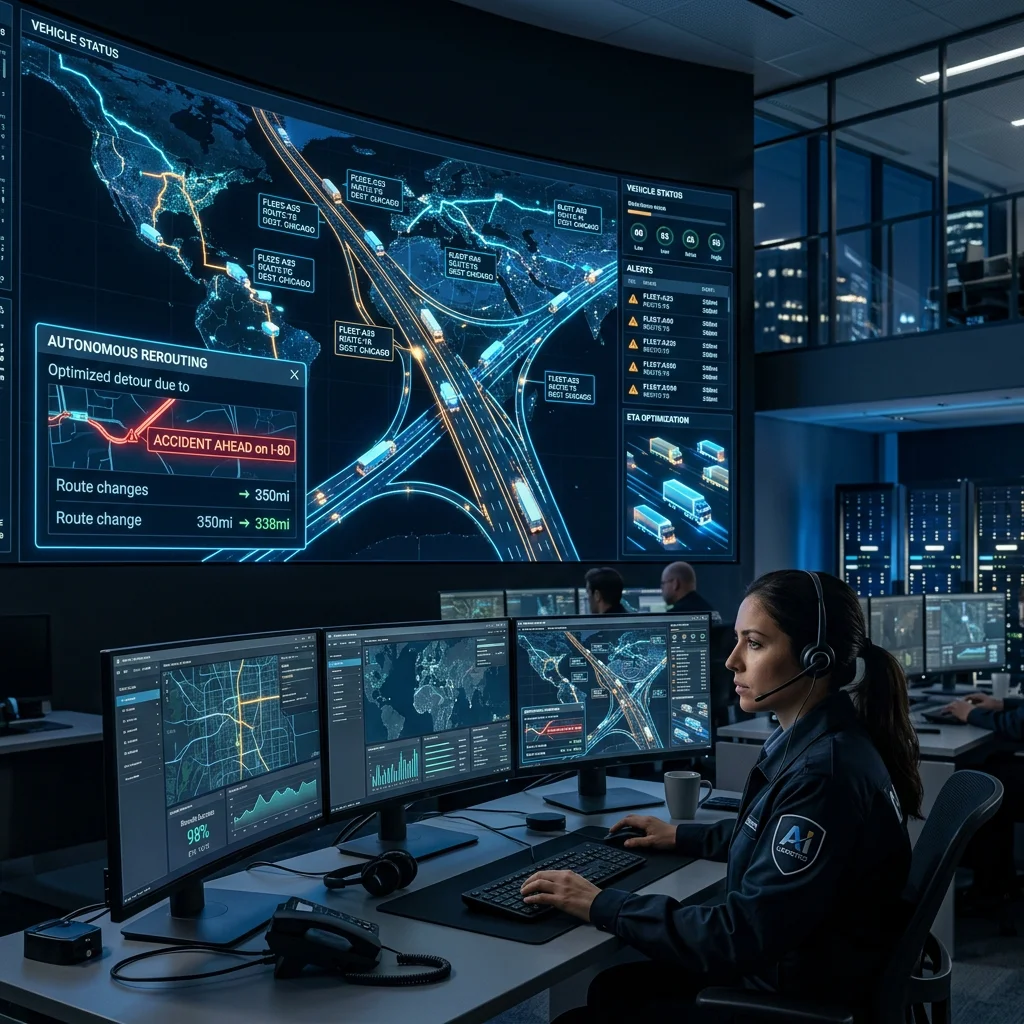
Large language models (LLMs) have evolved from passive conversational interfaces into active decision agents capable of orchestrating complex workflows. In supply chain and fleet operations, the promise of autonomous agents lies in their ability to ingest unstructured disruption signals — weather warnings, driver messages, port delay notifications — and dynamically evaluate corrective actions.
However, delegating operational decisions directly to a probabilistic neural network introduces severe risks. While an LLM excels at interpreting natural language context and generating candidate recovery scenarios, it lacks the mathematical guarantees required for hard vehicle routing and timetable constraints.
Generative AI models are moving beyond text summaries to dynamic decision agents — but deploying autonomous LLMs in real-time freight routing requires pairing probabilistic reasoning with deterministic optimization solvers.
§ 02The Hybrid Architecture: LLM Reasoning + Solvers
The workable architecture for operational AI is a hybrid design: the LLM acts as the context parser and scenario translator, while a classical mixed-integer programming (MIP) or constraint programming (CP) solver executes the math. When a port strike or highway closure occurs, the LLM parses the incoming advisory, translates it into updated cost matrices and capacity bounds, and triggers the mathematical solver to produce an optimal re-routing plan.
This division of labor ensures explainability and compliance while retaining the flexibility of generative AI. Industrial operators gain real-time adaptability without sacrificing constraint enforcement or safety margins.