The Maritime Cyber Range Series: Five Textbooks Built to Be Practised, Not Just Read
Five volumes, 160 chapters, and a hands-on lab at the end of every one. What is in the Maritime Cyber Range Series, what the Maritime Cyber Range platform actually is, and how the books and the platform work together.

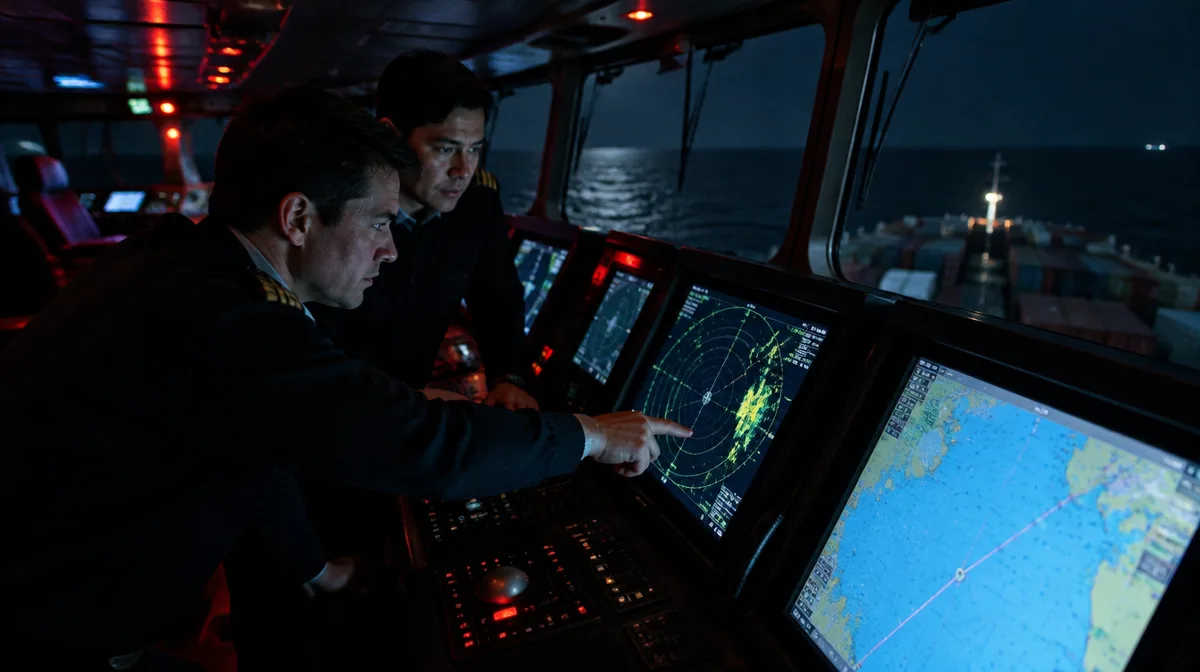
Maritime cybersecurity has a teaching problem. The incidents that matter, such as a spoofed GNSS position on the bridge, a terminal operating system that stops releasing containers or a dynamic positioning system fed bad data, happen on systems nobody can safely attack for practice. Students read about them, and some take part in an occasional drill. Very few work through an incident themselves before they face one for real.
The Maritime Cyber Range Series is our answer to that problem. It is a five-volume, 160-chapter course in maritime cybersecurity, written by Rahimeh Neamatian Monemi, PhD, and published by Sharkey Predictim Globe. Every chapter ends with a lab that can be run on a live training platform, the Predictim Maritime Cyber Range. This post explains what is in the books, what the platform is, and how the two fit together.
§ 01First, What Is a Cyber Range?
A cyber range is to cybersecurity what a ship simulator is to navigation: a safe, controlled environment that behaves like the real systems, where people can face an attack, make decisions under time pressure and get things wrong without consequences. Nothing on a working vessel or terminal is touched. The value comes from repetition. People who have already recognised a spoofed position or isolated a compromised workstation in an exercise do it faster and more calmly when it happens for real.
Most cyber ranges were built for corporate IT networks. A maritime range has to reproduce what IT ranges leave out: navigation systems, shipboard and port operational technology (OT), cargo and logistics data flows, and the handoffs between ship, shore and port, where responsibility is often least clear.
§ 02The Predictim Maritime Cyber Range Platform
The Predictim Maritime Cyber Range is a cybersecurity training and simulation platform covering the whole maritime chain in five connected modules: Vessel, Port, Shore, Supply Chain and Offshore. For a training academy or fleet operator, it provides four things.
A scenario library. more than 900 realistic attack scenarios across the five modules, including GNSS spoofing, ECDIS tampering, OT and PLC tampering, ransomware, cold-chain data falsification and supply-chain compromise, each played out under realistic time pressure.
A way to measure skill. 406 competencies in seven areas, from threat detection and OT security to compliance and navigation, are linked to each scenario and aligned with IMO Resolution MSC.428(98), so each learner's record shows which skills they have practised. A single pass mark would hide most of that information.
Structure and control for instructors. Twenty-six guided learning pathways take learners from foundational drills to a three-tier certification path. From the instructor console, trainers can launch, pause, inject events into and stop live scenarios, including exercises that run across bridge, port and shore teams at the same time.
Organisation-wide deployment. The platform is multi-tenant, with organisation branding, SSO/SAML, usage analytics and audit logging, so an academy or a fleet can roll it out at scale and show evidence of readiness against IMO, NIS2 and flag-state requirements.
§ 03Five Volumes, One for Each Layer of the Operation
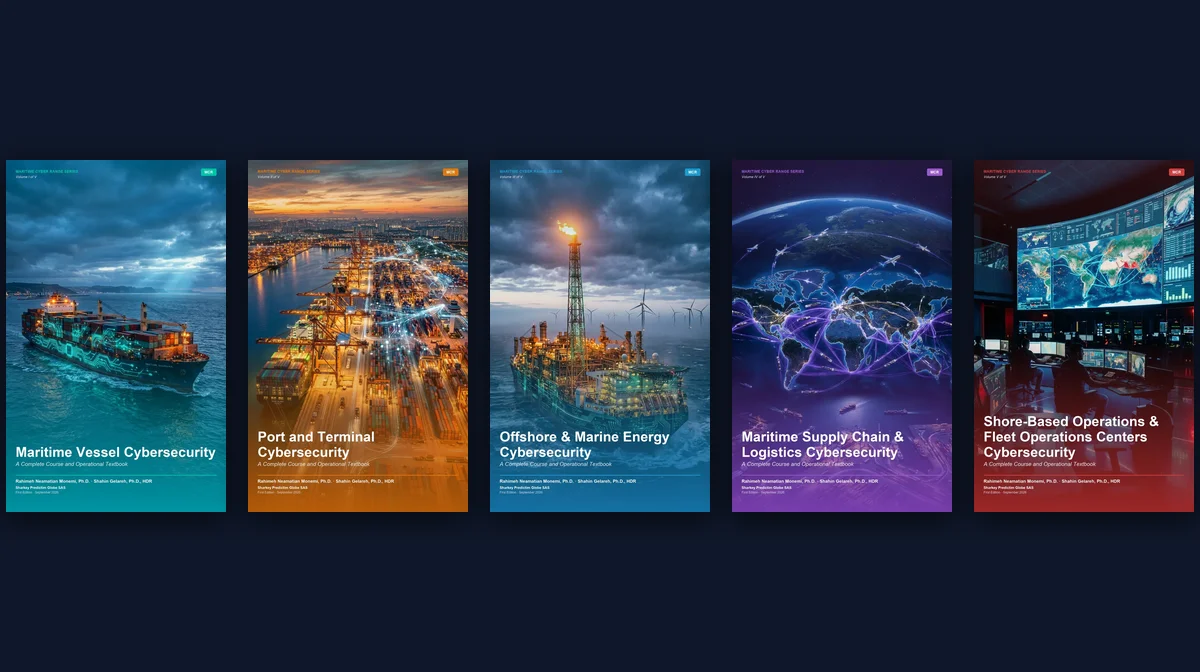
The series follows the same five-part structure as the platform, so each book corresponds to one module of the range.
Volume I, Maritime Vessel Cybersecurity (40 chapters): shipboard OT, bridge navigation and autonomous ships, from GNSS jamming and spoofing, AIS and ECDIS chart integrity through to incident response and compliance under IMO MSC.428(98), IACS UR E26/E27 and IEC 62443.
Volume II, Port and Terminal Cybersecurity (30 chapters): terminal operating systems, automated cranes, gate control and port facilities.
Volume III, Offshore & Marine Energy Cybersecurity (30 chapters): dynamic positioning, subsea OT and offshore wind.
Volume IV, Maritime Supply Chain & Logistics Cybersecurity (30 chapters): intermodal tracking, EDI and BAPLIE messaging, and customs.
Volume V, Shore-Based Operations & Fleet Operations Centers Cybersecurity (30 chapters): fleet telematics, coastal VTS and remote operations centres.
Together they run to 160 chapters and more than 1,400 pages. Each volume stands on its own: a port authority can start with Volume II, and an academy teaching STCW cyber content can start with Volume I.
§ 04How Every Chapter Is Built
Every chapter follows the same structure: learning objectives, key terminology, a documented incident or a clearly labelled illustrative scenario, a safety warning, a step-by-step technical runbook, a mapping to the relevant regulatory and industry frameworks, and a closing Platform Lab Session.
The series has been audited against its sources. Documented incidents are cited and kept separate from illustrative reconstructions, so readers always know which one they are looking at.
§ 05Where the Book Meets the Range
Each of the 160 printed labs has a matching guided-simulation scenario on the Maritime Cyber Range, identified by the same exercise ID: CORE-VES-501 to CORE-VES-540 for Volume I, for example. A reader can finish the chapter on GNSS spoofing and then open the matching scenario, with a bridge display that disagrees with the radar picture, a clock running down and a decision to make. The chapter teaches the procedure; the platform tests whether the reader can apply it.
The books are complete without the platform. Readers who want the hands-on labs can request access for the volumes they own. Instructors who adopt the series can request lecture slides and an instructor guide with worked lab solutions. Both are supplied to verified instructors on request and are not published openly, because the guide contains the answers.
§ 06Availability
At the time of writing, Volumes I and IV are available in paperback on Amazon, and Volumes II, III and V are forthcoming. Academies, universities and training centres can request a review copy or an institutional licence from the series page. Organisations interested in the platform itself can book a walkthrough of the Maritime Cyber Range and discuss a pilot that starts with one module and one cohort.
Not ready for a project? Ask an engineer your question by email. No call needed.
Ask a question