Rail Slot Allocation: Scheduling Trains on Shared, Congested Track
On a busy railway, every train needs a path through the network that does not conflict with any other. Passenger, freight and maintenance all compete for the same track. Slot allocation is the planning problem that decides who gets which path, and it is one of the hardest in transport.

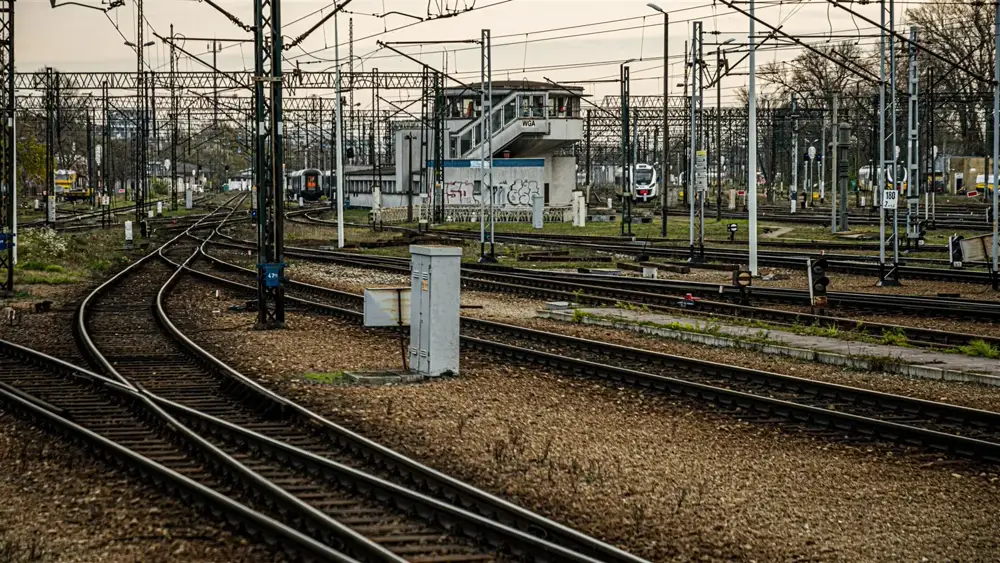
A railway line is a shared resource that only one train can use at a time on each section. Before any train runs, the infrastructure manager must give it a path: a sequence of track sections with times, from origin to destination, that keeps a safe distance from every other train. On a quiet branch line this is easy. On a busy corridor shared by fast passenger trains, slower regional services and heavy freight, it is one of the hardest planning problems in transport.
The process is often called path or slot allocation. Train operators request paths, the infrastructure manager builds a timetable that satisfies as many requests as possible, and conflicts are resolved by rules and negotiation. Optimisation models are increasingly used to support each step.
§ 01Why Mixed Traffic Eats Capacity
Capacity on a line is not a fixed number of trains per hour. It depends on the mix. If every train runs at the same speed and stops at the same places, trains can follow each other closely. When a fast train follows a slow one, the gap must grow so the fast train does not catch up before the next place where it can overtake. A single slow freight train in a stream of fast passenger trains can use the capacity of several.
This is why the order and grouping of trains matters so much. Bundling trains of similar speed together, and placing overtaking points well, can free a lot of capacity on the same infrastructure. The timetable itself is a capacity decision.
§ 02The Optimisation Problem
Mathematically, timetabling is a scheduling problem on a network. Each train has a requested departure time, a route, running times between points and minimum dwell times at stops. Headway constraints keep a minimum time between trains on each section, and further constraints handle single-track sections where trains in opposite directions must meet at passing loops.
A common formulation, the periodic event scheduling problem, is used for regular-interval timetables where services repeat every hour. For freight and irregular traffic, models assign paths in a time-expanded network. Both quickly become large, and exact methods are often combined with decomposition and heuristics to handle a full national network.
§ 03Robustness Is Part of the Objective
A timetable that packs trains as tightly as possible looks efficient on paper but spreads delays in practice. One late train delays the next, and the delay propagates along the line and into connecting services. So planners add buffer times between trains and recovery time in running times.
Where to place these buffers is itself an optimisation question. A buffer behind a train that is often late is worth more than one behind a train that is usually on time. Models that use historical delay data can place buffers where they absorb the most disruption for the capacity they consume.
§ 04Maintenance Needs Paths Too
Track maintenance needs access to the line, and closing a section affects every train that would have used it. Planning maintenance possessions together with the timetable, rather than after it, lets planners choose windows that disturb the fewest trains, bundle works on the same section, and plan diversions in advance.
This is where timetabling meets predictive maintenance. If the condition of a section can be forecast, its maintenance can be scheduled into planned windows instead of emergency closures, which protect the timetable much better.
§ 05Where Decision Support Helps
Decision-support tools for slot allocation typically help in three places: checking requested paths for conflicts and suggesting nearby feasible alternatives, evaluating how much capacity remains on a corridor for new services, and measuring the robustness of a draft timetable by simulating realistic delays.
None of these replaces the rules and negotiations between infrastructure managers and operators. They give everyone a shared, quantified view of what the network can carry, which makes those negotiations shorter and the resulting timetable more reliable.
Not ready for a project? Ask an engineer your question by email. No call needed.
Ask a question