Yard Crane Scheduling: Sequencing Under Physical and Time Constraints
Quay cranes get the attention, but in many terminals the yard decides the pace. Yard cranes must serve vessels, trucks and trains at once, on shared rails, without blocking each other. Here is how their work is sequenced and why it is harder than it looks.


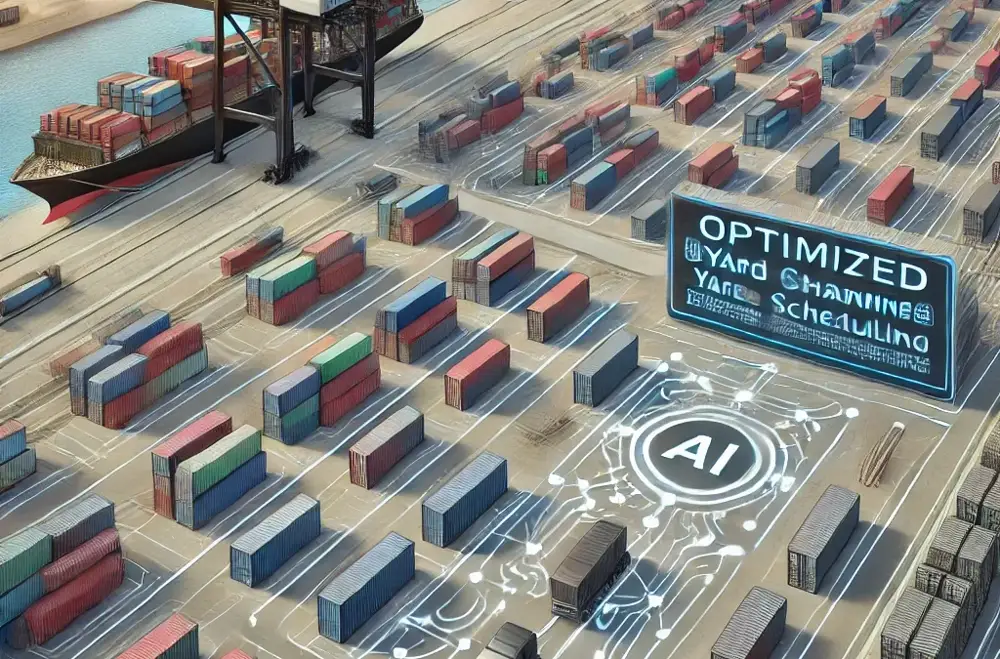
When people picture a container terminal, they picture the large quay cranes lifting boxes on and off ships. Behind them, the yard is where containers wait, sometimes for days, between the ship and the truck or train. Yard cranes, rubber-tyred or rail-mounted gantries in most terminals, move containers within the stacks and hand them to the vehicles that serve the quay and the gates.
If the yard cannot deliver the right container at the right moment, the quay crane waits, and the vessel's stay grows longer. In many terminals, yard productivity is the real limit on how fast ships are worked. Scheduling yard cranes well is therefore central to terminal performance.
§ 01Many Customers for One Crane
A yard crane serving a block of stacks has several kinds of jobs. Loading jobs retrieve export containers for a vessel, in a sequence set by the stowage plan. Discharge jobs store import containers arriving from the quay. Gate jobs serve trucks that arrive to collect or deliver containers, often with appointments but also unannounced. Rail jobs serve trains with their own windows. And housekeeping jobs reorganise the stacks during quiet periods.
These jobs compete. A truck waiting at the block wants service now; the vessel being loaded needs its next container in a few minutes; the housekeeping move would make tomorrow's loading faster. The scheduling problem is to decide the order of jobs for each crane over the next few hours, balancing the cost of each kind of wait.
§ 02Physical Constraints
Yard cranes move slowly compared with the time a lift takes, so travel between bays matters. When two or more cranes share the same rails in a block, they cannot pass each other and must keep a safe distance. This creates interference: a crane may have to wait or detour because its neighbour is working nearby.
Stacking adds another constraint. Containers are stacked several high, and to reach one at the bottom the crane must first move the ones above it. These extra moves, called rehandles or reshuffles, can take a large share of crane time if the stack was built without thinking about retrieval order.
§ 03Stacking and Scheduling Belong Together
Many rehandles are created at the moment a container is stored. If an export container that will be loaded early ends up under one loaded later, a rehandle is almost guaranteed. Placement rules that take into account the expected retrieval order, vessel, port of discharge, weight class and loading sequence, reduce this risk.
Import containers are harder, because the truck pickup order is uncertain. Using appointment data and dwell-time predictions to group containers likely to leave at similar times reduces rehandles at the gate. Housekeeping moves can then fix the worst stacks in advance, when cranes would otherwise be idle.
§ 04How the Problem Is Solved
Yard crane scheduling is a scheduling problem with sequence-dependent travel times, time windows for vessel and rail jobs, uncertain arrivals for trucks, and non-crossing constraints between cranes. Exact models can solve small horizons, but the problem changes every few minutes as trucks arrive and the quay progresses. Most practical systems therefore re-optimise on a rolling horizon, combining fast heuristics with exact methods for the near-term sequence.
The objectives need explicit weights: vessel delays usually cost the most, then truck waiting times, then crane travel and rehandles. Making these weights visible lets the terminal choose its priorities instead of leaving them to an algorithm's default.
§ 05Where to Start
Terminal operating systems record every crane move. Analysing a few weeks of these logs shows how much crane time goes into travel, rehandles and waiting, and how often quay cranes waited for the yard. These figures point to whether the main gain lies in sequencing, in stacking rules or in crane deployment across blocks.
Yard and berth planning are linked. The yard plan for a vessel only works if the berth plan holds, so the most useful models look at quay, yard and gate together rather than optimising each in isolation.
Not ready for a project? Ask an engineer your question by email. No call needed.
Ask a question