Cutting the disruption-to-decision gap from 15 minutes to 2
Semantic middleware that reads plain-language shift-floor logs and turns them into validated constraints — across six different scheduling and logistics problem types

These figures match the published metrics on the Predictim GenOR-Twin product page — this walkthrough is a composite scenario, not a specific engagement.
Semantic middleware that reads plain-language shift-floor logs and turns them into validated constraints — across six different scheduling and logistics problem types
Segment: Cross-domain disruption response
Operational disruptions get reported in plain language — a maintenance note, a delayed-crew email, a staff member calling in unavailable — while the schedule lives in a separate mathematical model nobody updates in real time. Someone has to read the note, judge what it actually means for the plan, and manually re-enter it as a constraint, and that translation step is where response time is lost. A language model can read the note in seconds, but taken alone it can also misread an ambiguous one — inventing a resource that doesn't exist or a duration that isn't there — which is exactly the failure mode a validation-conscious operations team can't tolerate.
How the deployment was structured
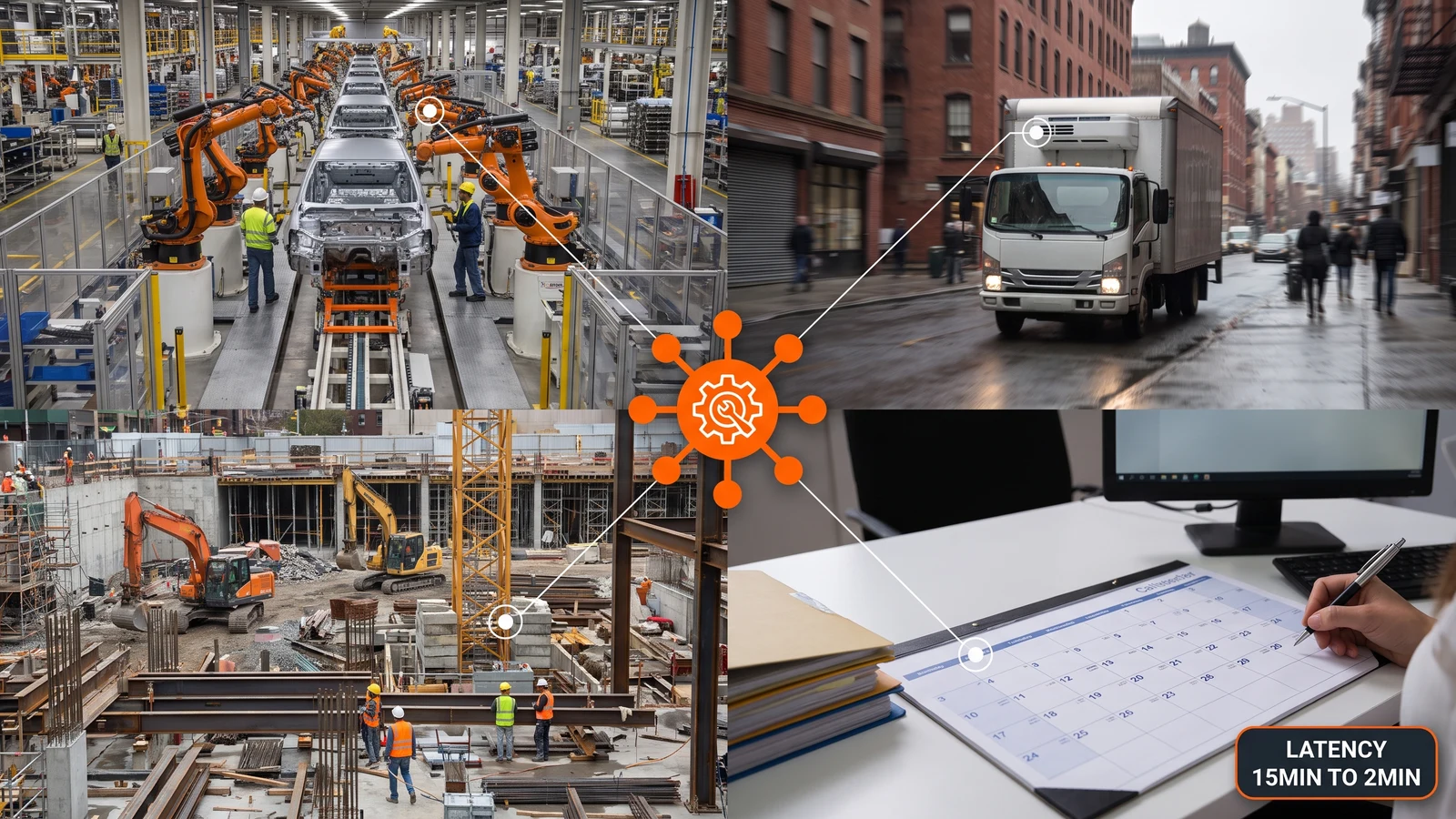
The same note, four different problem types
A machine fault, a traffic delay, an unavailable inspector, and a staff absence all start as the same kind of plain-language note — and each gets parsed into the constraint format its own scheduling model actually needs, whether that's job shop scheduling, vehicle routing, project scheduling, or workforce rostering.
Checked against a knowledge graph before it counts
Every extracted constraint is validated against a symbolic knowledge graph before it can reach the solver — in offline validation, this caught 88.2% of the incorrect or hallucinated extractions a language model produced on its own.
Repair, re-optimize, or ask a person
An adaptive policy chooses between a fast local repair, a full re-optimization, or escalation to human review, based on how confident the extraction is and how much slack the schedule has left.
Validated across six NP-hard domains
The same semantic-to-symbolic pipeline was tested across job shop scheduling, vehicle routing, project scheduling, nurse rostering, bin packing, and network flow — not tuned to one industry's vocabulary.
The gain shows up in the automotive validation study this was tested against: cutting decision latency from 15 minutes to 2 by removing the manual note-to-constraint translation step — the same pipeline that, without retuning, extracted correct constraints across five other scheduling domains.
Related reading
Nurse Rostering When the Absences Arrive by Text Message
Nurse rosters are built carefully weeks in advance and then rebuilt, piece by piece, from messages that arrive at 5 a.m. The planning model is rarely the weak point. Getting the message into it is.
ReadLet the LLM Translate, Not Solve: How Shift Notes Become Safe Scheduling Constraints
Most schedule disruptions arrive as a sentence, not a data field. Large language models can read that sentence. They should not be trusted to plan around it — and they don't need to be.
ReadGenerative AI in Supply Chain Management: From Scenario Planning to Synthetic Foresight
Generative AI is reshaping how planners reason about uncertainty — moving from static scenarios to synthetic, multi-modal foresight that adapts in real time.
ReadOther use cases
All use cases
A cost contingency you can defend when the risk assessments disagree
View
When the consensus says 0.25%, and one claim says otherwise
View
Cutting damage claims and load time across a multi-site grocery network
ViewReady to optimize your operations?
Talk to our research team about your operational challenge. Receive a tailored technical proposal within 72 hours.