Turning “off sick tonight” into an updated nurse roster
Absence messages read, checked against the ward's staff and skills, and turned into roster changes — with a manager pulled in only when the message is unclear

These figures match the published metrics on the Predictim GenOR-Twin product page — this walkthrough is a composite scenario, not a specific engagement.
Absence messages read, checked against the ward's staff and skills, and turned into roster changes — with a manager pulled in only when the message is unclear
Segment: Hospital nurse rostering
The roster lives in a scheduling model; the disruptions live in messages, calls and handover notes. A ward manager has to translate each one by hand, often at night, and either patch the roster locally or rebuild it — without much time to check whether the patch quietly breaks a skill-mix or rest-time rule somewhere else.
How the deployment was structured
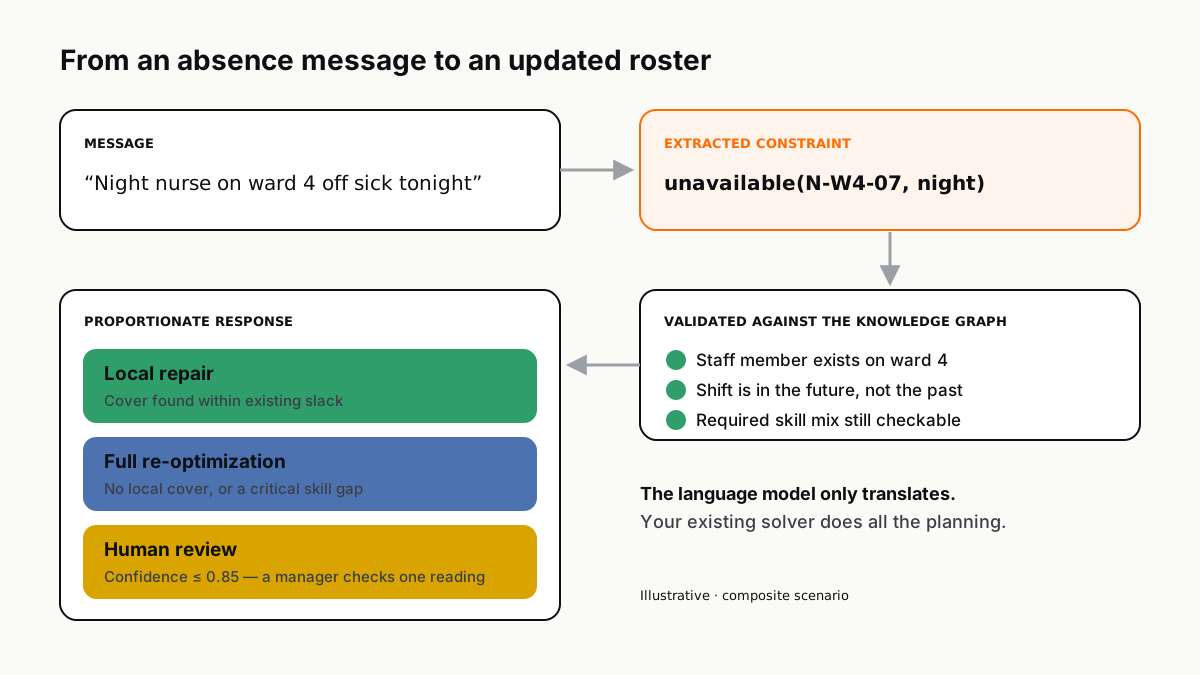
Read the message, propose the constraint
A message like “night nurse on ward 4 off sick tonight” is translated into a constraint the rostering model understands — this person, this shift, unavailable — with a confidence score attached.
Checked before it touches the roster
The proposed constraint is validated against the ward's knowledge graph: the staff member exists on that ward, the shift is in the future, and the change is physically possible. In offline validation, this layer caught 88.2% of the incorrect extractions a language model produced on highly ambiguous messages.
A response sized to the problem
If cover exists within the roster's slack, it's a local repair. If not, or if a critical skill would be missing, the roster is fully re-optimized. If the system isn't confident it understood the message, a manager checks that one interpretation instead of rebuilding the roster.
Nurse scheduling is one of the six problem types GenOR-Twin was validated on. The figures above come from that published evaluation: 299 of 300 annotated logs translated exactly as experts read them, and planners working with the system picked the right type of response 98.0% of the time, against 79.5% working alone.
Related reading
Let the LLM Translate, Not Solve: How Shift Notes Become Safe Scheduling Constraints
Most schedule disruptions arrive as a sentence, not a data field. Large language models can read that sentence. They should not be trusted to plan around it — and they don't need to be.
ReadGenerative AI in Supply Chain Management: From Scenario Planning to Synthetic Foresight
Generative AI is reshaping how planners reason about uncertainty — moving from static scenarios to synthetic, multi-modal foresight that adapts in real time.
ReadOther use cases
All use cases
Cutting damage claims and load time across a multi-site grocery network
View
Holding a 98%+ on-time rate through a mixed van and cargo-bike last-mile fleet
View
Arbitrating a dry-season shortage across municipal, agricultural, and industrial demand
ViewReady to optimize your operations?
Talk to our research team about your operational challenge. Receive a tailored technical proposal within 72 hours.