Holding a 98%+ on-time rate through a mixed van and cargo-bike last-mile fleet
Dynamic dispatch across a heterogeneous fleet serving dense urban delivery windows
These figures match the published metrics on the Predictim Routing product page — this walkthrough is a composite scenario, not a specific engagement.
Dynamic dispatch across a heterogeneous fleet serving dense urban delivery windows
Segment: Regional last-mile parcel delivery
A last-mile fleet is rarely uniform: some vehicles can enter restricted city-centre zones and others can't, drivers hold different route certifications, and customer delivery windows are contractually hard, not preferences. Manual dispatch handles the common case reasonably well, but any late-arriving order, cancellation, or traffic incident forces a rebuild that eats into dispatcher time and pushes some deliveries outside their promised window.
How the approach works
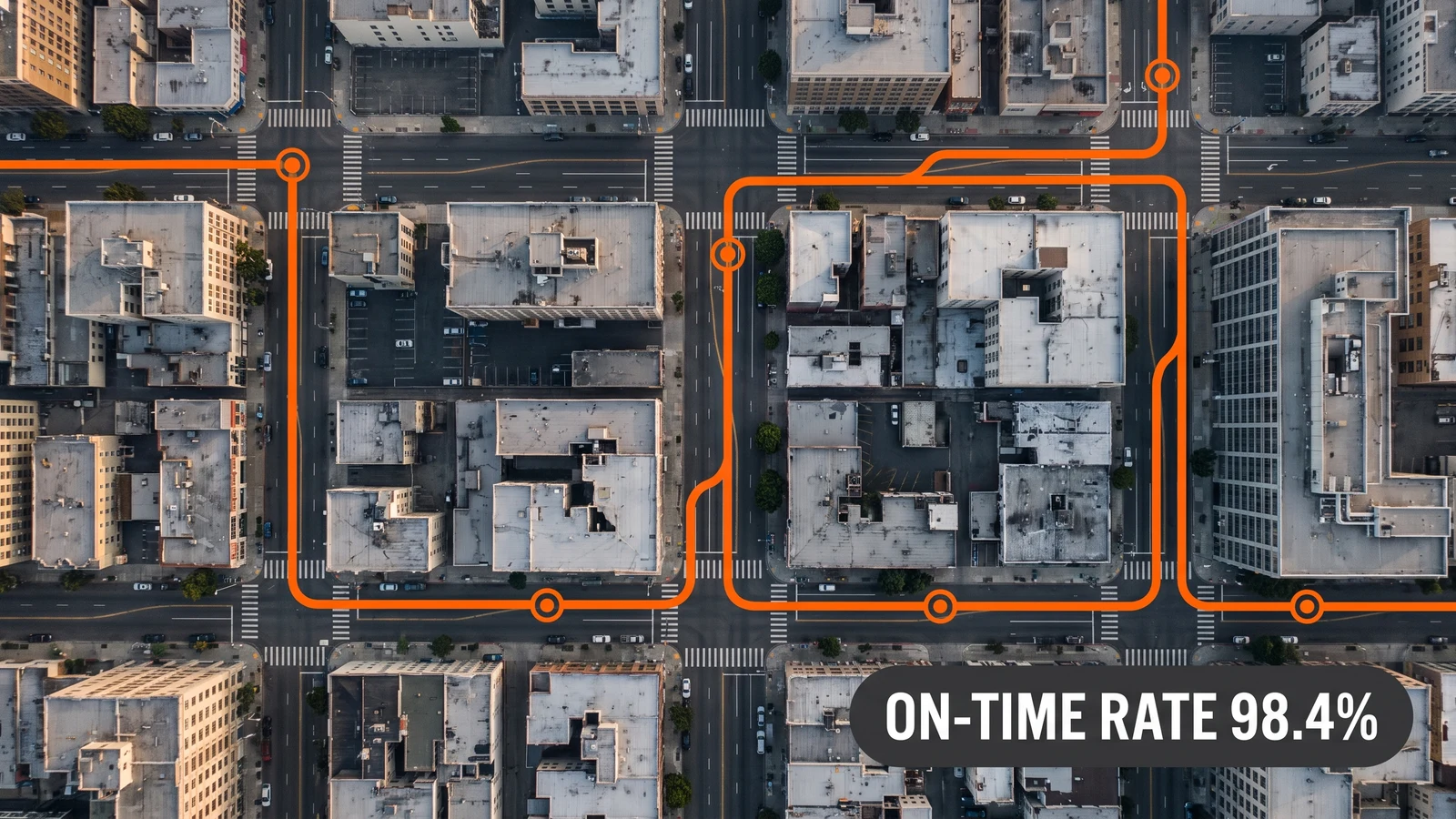
Fleet-aware assignment
The solver matches each stop to a vehicle that's actually allowed to make it — respecting zone access, vehicle type, and driver skill constraints instead of assuming a uniform fleet.
Hard windows, not soft penalties
Customer delivery windows and driver-hour rules are enforced as hard constraints, so a route that looks efficient on paper can't quietly violate a promised window.
Continuous re-optimisation
Routes update as orders are added, cancelled, or rescheduled through the day, without dispatchers manually rebuilding a plan from the point of disruption.
Traffic-adaptive re-routing
When live or predicted traffic pushes a route past its delay tolerance, re-optimisation triggers automatically rather than waiting for a dispatcher to notice.
Moving dispatch from a manual, reactive process to continuous re-optimisation is what lets a mixed fleet — vans and cargo bikes, different zone permissions, different drivers — hold a consistent on-time rate instead of degrading every time something changes mid-day.
Related reading
Time Windows: The Constraint That Quietly Breaks Last-Mile Plans
Most last-mile routes look efficient on a map. What makes them fail in practice is usually not distance but time windows — and how a single late stop pushes every later promise out of reach.
ReadTransport and Logistics Mobility Management: Unifying Fleet, Route, and Modal Decisions
Fleet management, route optimization, and modal choice are usually run as three separate decisions made by three separate teams — which is exactly why the network keeps finding costs none of the three could see alone.
ReadDelivery Capacity Analytics: Matching Available Capacity to Demand in Real Time
Most fleets don't run out of capacity — they run out of visibility into the capacity they already have. Delivery capacity analytics closes that gap by scoring, not just counting, what's available right now.
ReadOther use cases
All use cases
Turning “off sick tonight” into an updated nurse roster
View
Re-planning routes from what drivers actually report
View
A cost contingency you can defend when the risk assessments disagree
ViewReady to optimize your operations?
Talk to our technical team about your operational challenge. An engineer replies within 72 hours, Monday to Friday.