Cutting pick-path travel time across a multi-client 3PL floor
Continuous slotting and pick-path optimisation for a warehouse running several clients' SKU catalogues on one floor
These figures match the published metrics on the Predictim Warehousing product page — this walkthrough is a composite scenario, not a specific engagement.
Continuous slotting and pick-path optimisation for a warehouse running several clients' SKU catalogues on one floor
Segment: Multi-client 3PL warehousing
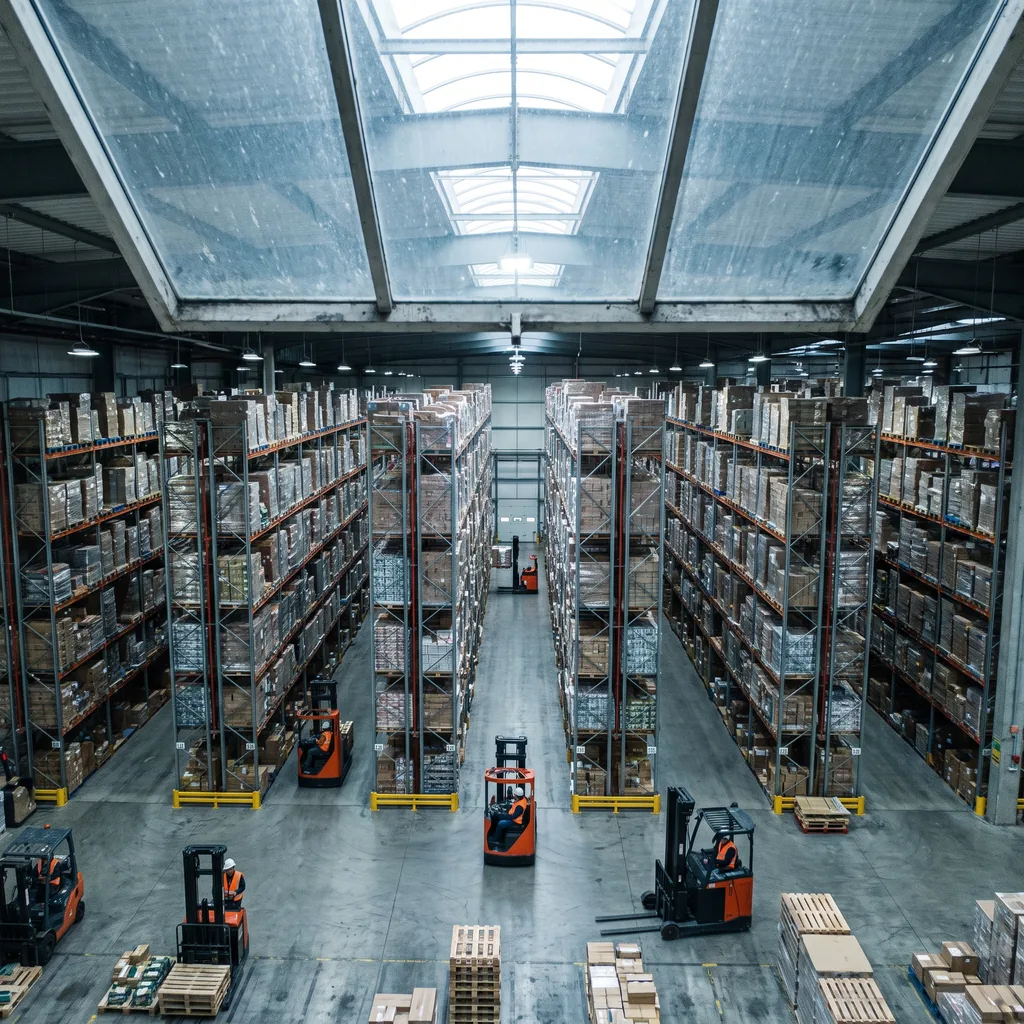
Warehouse layouts are typically set during onboarding and rarely revisited, even as each client's order mix changes week to week. Pickers walk longer routes than necessary, wave planning is built around a static map rather than actual congestion, and nobody has a clear, quantified view of which station or lane is actually limiting throughput on a given shift.
How the deployment was structured
Continuous re-slotting, not a one-time layout
SKU placement is re-evaluated continuously against demand, so high-velocity items for any client migrate to the most accessible slots as order mix shifts.
Pick paths against the real graph
Pick paths are calculated against the warehouse's actual aisle-direction conventions, congestion hotspots, and equipment availability — not an idealised floor plan.
Wave and batch picking, sequenced
Wave planning, batch picking, and multi-order picking give pickers sequenced instructions instead of a map to interpret themselves.
Bottleneck diagnostics, not guesswork
When throughput stalls on a shift, operations leads see exactly which station or lane is the binding constraint and what would unblock it.
Re-slotting continuously instead of once at onboarding is what keeps pick paths short as each client's order mix shifts — the throughput visibility Predictim Warehousing is built to give a multi-client floor.
Related reading
Solar-Powered Mobility in Warehouse Logistics: Where the Economics Actually Work
Solar panels on a warehouse roof and electric material-handling equipment on the floor are often pitched as one story — but they only pay off together under a narrower set of conditions than the marketing suggests.
ReadAI-Driven Demand Sensing: Moving Beyond Traditional Statistical Forecasting
Demand sensing replaces slow-moving statistical forecasts with a near-real-time read on demand, built from point-of-sale, weather, and market signals the moment they shift — not weeks after.
ReadThe Economics of Micro-Fulfillment Centers in Last-Mile Delivery
A micro-fulfillment center shortens the last mile by design — the question that actually determines ROI is whether the demand density around it is high enough to keep it busy without cannibalizing a nearby store or larger DC.
ReadOther use cases
All use cases
Turning “off sick tonight” into an updated nurse roster
View
Re-planning routes from what drivers actually report
View
A cost contingency you can defend when the risk assessments disagree
ViewReady to optimize your operations?
Talk to our research team about your operational challenge. Receive a tailored technical proposal within 72 hours.