Proving fleet-wide cyber-readiness, not just running a drill
Structured cyber-security training and certificates of completion across Vessel, Port, Shore, Supply Chain, and Offshore modules for a training academy or fleet operator

These figures match the published metrics on the Predictim Maritime Cyber Range product page — this walkthrough is a composite scenario, not a specific engagement.
Structured cyber-security training and certificates of completion across Vessel, Port, Shore, Supply Chain, and Offshore modules for a training academy or fleet operator
Segment: Maritime training academy compliance
Traditional maritime cyber training tools cover one ship, one module, one location — a bridge simulator teaches an officer to react to a single scenario, but says nothing about whether port operations, shore IT, and supply-chain partners could coordinate during a real incident. Regulators increasingly expect organisations to demonstrate — not assert — readiness in line with IMO 2021, NIS2, and flag-state expectations, and a single-module simulator has no way to produce that evidence.
How the approach works
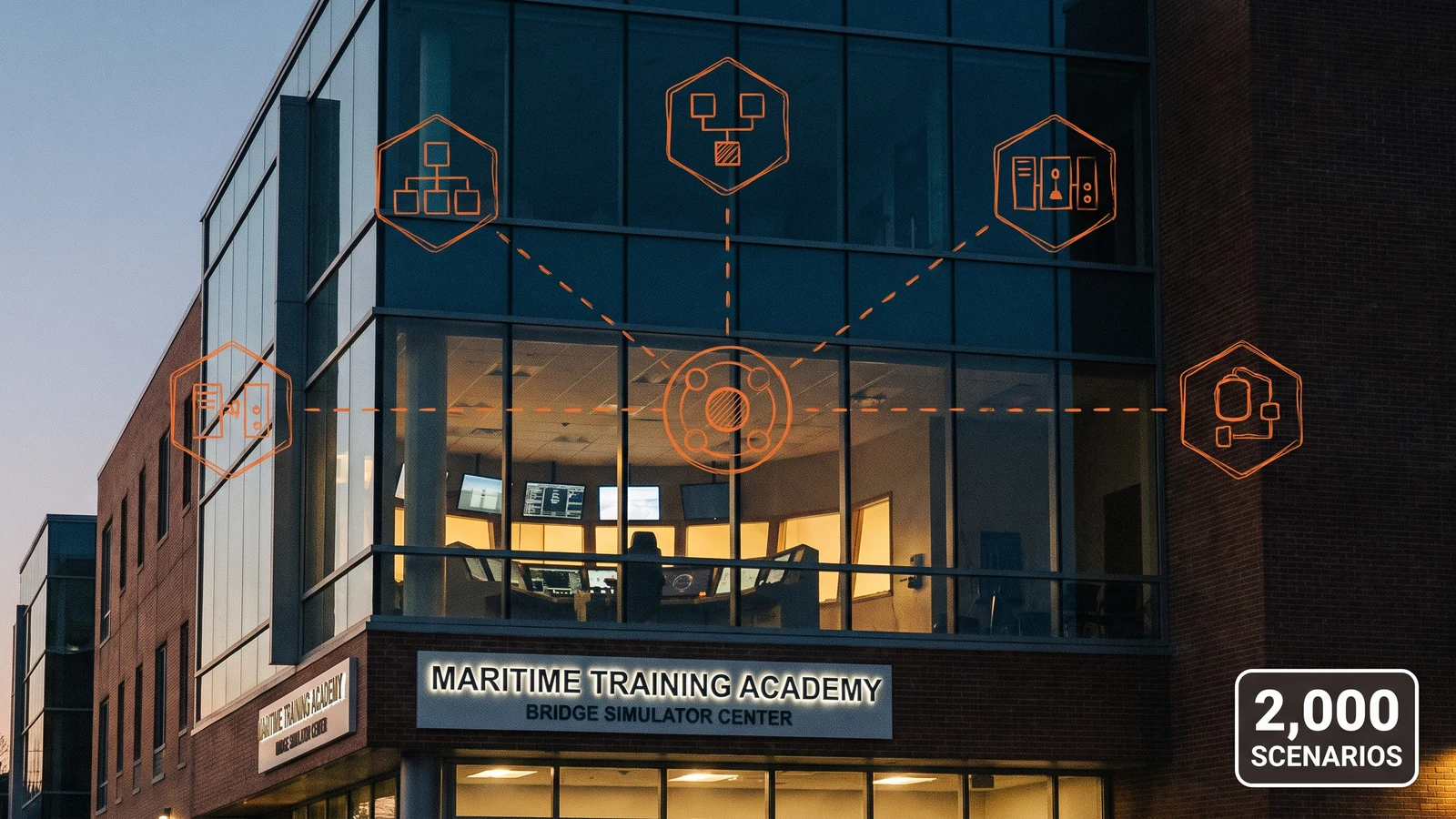
Five connected modules, one range
Vessel, Port, Shore, Supply Chain, and Offshore scenarios run in the same range, so an exercise can move an incident across the whole chain the way a real one would.
Competencies aligned with IMO guidance
406 competencies in seven areas, aligned with IMO MSC.428(98), are linked to every scenario, so each exercise shows which skills a learner has practised.
Guided pathways to a certificate of completion
Structured pathways carry learners from foundational drills through three course levels to a Predictim certificate of completion, backed by an auditable training record rather than a checkbox. It is not an IMO or STCW certificate.
Live instructor-led sessions
Instructors schedule, launch and pause live scenario sessions for a cohort and review results across bridge, engine room, port and shore teams.
Running the incident across all five modules at once — not one bridge simulator at a time — is what lets an academy produce evidence of fleet-wide readiness instead of a single officer's drill record.
Related reading
What a Maritime Cyber Drill Should Actually Test
Most maritime cyber exercises test whether people can recognize a phishing email. The incidents that matter at sea look different: a navigation display that disagrees with the window, a cargo system that stops responding mid-operation.
ReadOT/IT Convergence in Ports: Why Maritime Cyber Risk Is Now an Operational Risk
A crane scheduling system and a corporate email server used to live on separate networks with separate risk owners. In a modern port, they're often the same network — and the same incident.
ReadMaritime Cyber Range as a Service: How SaaS Delivery Changes the Economics of Crew Training
A cyber range that lives in a data center instead of a simulator room changes more than deployment logistics — it changes who can afford recurring, fleet-wide training and how fast new attack scenarios reach every crew.
ReadOther use cases
All use cases
Turning “off sick tonight” into an updated nurse roster
View
Re-planning routes from what drivers actually report
View
A cost contingency you can defend when the risk assessments disagree
ViewReady to optimize your operations?
Talk to our technical team about your operational challenge. An engineer replies within 72 hours, Monday to Friday.